Welcome to XiYu

What Materials Are Commonly Used for Metal Stamping?
Compare common metal stamping materials including stainless steel, carbon steel, aluminum, copper, brass and phosphor bronze, and learn how material properties affect stamping performance and cost.

Choosing the right material is one of the most important decisions in a metal stamping project.
The material affects not only the performance of the finished component, but also how easily it can be punched, bent, drawn, formed, and produced repeatedly.
Common metal stamping materials include stainless steel, carbon steel, mild steel, aluminum, copper, brass, and phosphor bronze. Each offers different characteristics in terms of strength, corrosion resistance, conductivity, weight, formability, appearance, and cost.
For OEM and ODM projects, there is rarely one “best” stamping material for every application.
The correct choice depends on the function of the part, its geometry, required tolerances, production environment, surface treatment, and expected production volume.
This guide compares the most common materials used in precision metal stamping and explains what engineers and buyers should consider before specifying a material.
Why Does Material Selection Matter in Metal Stamping?
Metal stamping applies controlled force to sheet metal to create features such as:
- Holes
- Slots
- Bends
- Tabs
- Flanges
- Ribs
- Drawn sections
- Formed contours
Different materials react differently to these operations.
A material that works well for a simple flat bracket may behave very differently when used for a component with deep draws or multiple tight bends.
Material selection can influence:
| Factor | Why It Matters |
|---|---|
| Formability | Determines how easily the material can be bent or drawn |
| Strength | Affects structural and mechanical performance |
| Hardness | Influences forming force and tool wear |
| Springback | Affects final bend angles and dimensional control |
| Corrosion Resistance | Important for outdoor, humid or chemical environments |
| Conductivity | Critical for electrical and electronic components |
| Weight | Important in automotive, electronics and portable products |
| Surface Finish | Can affect cosmetic appearance and finishing requirements |
| Material Cost | Directly affects the unit cost of stamped parts |
This is why material selection should ideally happen together with part design and manufacturing review.
Common Materials Used for Metal Stamping
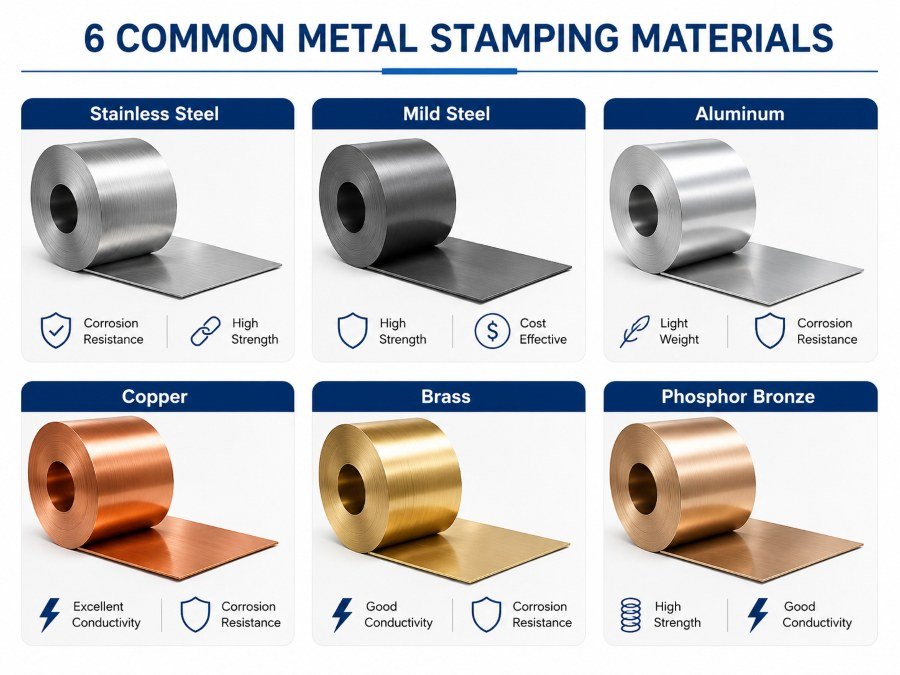
The following materials are frequently considered for custom stamped components.
| Material | Key Advantages | Main Considerations | Typical Applications |
|---|---|---|---|
| Stainless Steel | Strength, corrosion resistance, durability | Higher forming force, springback | Industrial, automotive, electronics |
| Carbon / Mild Steel | Strength, availability, cost efficiency | May require corrosion protection | Brackets, frames, structural parts |
| Aluminum | Lightweight, corrosion resistant | Scratching, springback | Electronics, lighting, consumer products |
| Copper | Excellent electrical and thermal conductivity | Higher material cost, softer surface | Electrical contacts, conductive parts |
| Brass | Good formability, appearance, conductivity | Alloy selection affects properties | Connectors, decorative hardware |
| Phosphor Bronze | Elasticity, fatigue resistance, conductivity | Higher material cost | Springs, clips, terminals |
Each group contains multiple grades and tempers, so the final material specification should be based on the actual application rather than only the general material name.
Stainless Steel for Metal Stamping
Stainless steel is widely used when a stamped component requires a combination of strength, corrosion resistance, durability, and a clean appearance.
Typical applications can include:
- Brackets
- Clips
- Covers
- Structural hardware
- Electronic components
- Automotive hardware
- Consumer product components
Advantages of Stainless Steel
Stainless steel can provide:
- Good corrosion resistance
- High strength
- Good wear resistance
- Attractive appearance
- Good temperature resistance
- Long service life
These properties make it suitable for components exposed to moisture, repeated handling, or demanding operating environments.
Challenges When Stamping Stainless Steel
Stainless steel can require greater forming force than softer materials.
Manufacturing considerations may include:
- Higher press force
- Greater tool wear
- Springback
- Galling
- Burr control
- Lubrication requirements
Tooling design and mold clearance therefore need to be matched to the specific stainless steel grade and thickness.
For complex parts, bend radii and forming sequence also require careful consideration.
Carbon Steel and Mild Steel for Stamping
Carbon steel and mild steel are commonly used for stamped parts where strength, availability, and cost efficiency are important.
Typical applications include:
- Mounting brackets
- Frames
- Supports
- Plates
- Structural hardware
- Machinery components
Advantages of Carbon and Mild Steel
These materials can offer:
- Good strength
- Good formability in suitable grades
- Wide availability
- Competitive material cost
- Compatibility with many surface treatments
Depending on the final application, stamped steel components may receive:
- Zinc plating
- Nickel plating
- Powder coating
- Painting
- Other protective finishes
Main Consideration: Corrosion Protection
Unlike stainless steel, many carbon steels require additional protection when the component is exposed to moisture or corrosive environments.
This means the lowest raw material price does not always result in the lowest final component cost.
The buyer should also consider the cost of the required surface treatment.
Aluminum for Metal Stamping
Aluminum is an important stamping material when low weight and corrosion resistance are priorities.
It is commonly used in:
- Electronics
- Lighting
- Consumer products
- Automotive components
- Housings
- Brackets
- Heat-related components
Advantages of Aluminum
Aluminum offers several useful characteristics:
- Low density
- Good corrosion resistance
- Good thermal conductivity
- Good electrical conductivity
- Attractive surface appearance
- Relatively easy machining
Its low weight is particularly useful for products where mass reduction is important.
Challenges When Stamping Aluminum
Although aluminum can be highly formable, manufacturing still requires careful process control.
Common considerations include:
- Surface scratching
- Material softness
- Springback
- Cracking during difficult bends
- Galling
- Alloy and temper selection
Not every aluminum alloy behaves the same way.
A grade selected mainly for strength may not have the same forming characteristics as a softer grade intended for sheet-metal fabrication.
Therefore, specifying only “aluminum” is usually not enough for an accurate manufacturing quotation.
Copper for Metal Stamping
Copper is commonly used when electrical or thermal conductivity is a primary functional requirement.
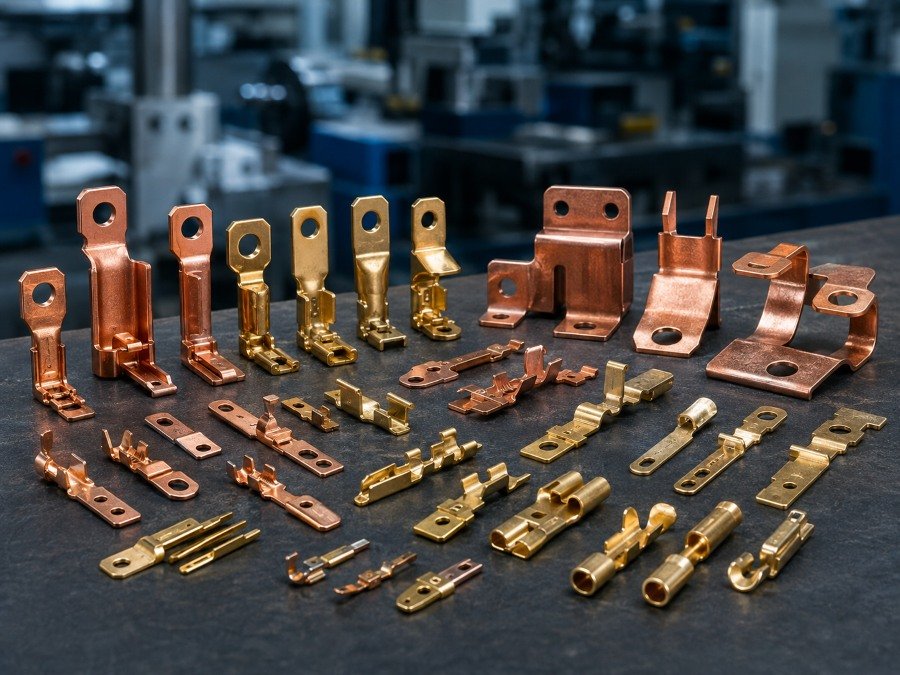
Typical stamped copper components include:
- Electrical contacts
- Conductive terminals
- Bus-related parts
- Heat-transfer components
- Electronic hardware
Advantages of Copper
Copper offers:
- Excellent electrical conductivity
- Excellent thermal conductivity
- Good formability
- Good corrosion resistance
- Reliable performance in electrical applications
Because of these characteristics, copper is particularly important in electrical and electronic products.
Manufacturing Considerations
Copper is relatively soft compared with many steels.
This can create challenges involving:
- Surface marks
- Handling damage
- Burr control
- Dimensional stability in thin sections
Material cost can also be significant.
For high-volume production, strip layout and material utilization therefore become especially important.
Brass for Metal Stamping
Brass is a copper-zinc alloy commonly used for components requiring good formability, conductivity, corrosion resistance, or decorative appearance.
Typical applications include:
- Electrical connectors
- Terminals
- Decorative hardware
- Clips
- Contacts
- Consumer product components
Advantages of Brass
Brass can provide:
- Good formability
- Good machinability
- Electrical conductivity
- Corrosion resistance
- Attractive appearance
Its natural color also makes it useful for components where the metal itself is part of the visible product design.
Brass Alloy Selection Matters
Different brass compositions can have different mechanical and forming properties.
Therefore, the selected alloy should be evaluated according to:
- Required strength
- Bend requirements
- Conductivity
- Appearance
- Corrosion environment
- Production method
Phosphor Bronze for Metal Stamping
Phosphor bronze is commonly selected for small precision components that require elasticity, fatigue resistance, and electrical conductivity.
It is particularly useful for:
- Spring contacts
- Clips
- Terminals
- Electrical connectors
- Retaining components
Why Is Phosphor Bronze Used for Spring Components?
Some stamped components must repeatedly flex and return to their original position.
In these applications, material elasticity and fatigue performance become important.
Phosphor bronze can provide a useful combination of:
- Spring properties
- Fatigue resistance
- Corrosion resistance
- Electrical conductivity
However, it is generally more expensive than common carbon steels, so it should be selected when its performance characteristics are justified by the application.
How Do These Metal Stamping Materials Compare?
A simplified comparison can help during early material selection.
| Property | Stainless Steel | Mild Steel | Aluminum | Copper | Brass | Phosphor Bronze |
|---|---|---|---|---|---|---|
| Strength | High | Medium-High | Low-Medium | Medium | Medium | Medium-High |
| Corrosion Resistance | High | Low without coating | High | Good | Good | Good |
| Electrical Conductivity | Low | Low | Good | Excellent | Good | Good |
| Weight | Medium | Medium | Low | High | High | High |
| Formability | Grade dependent | Generally good | Alloy dependent | Good | Good | Good |
| Material Cost | Medium-High | Generally low | Medium | High | Medium-High | High |
| Typical Use | Durable precision parts | Structural hardware | Lightweight parts | Electrical parts | Connectors / decorative | Spring contacts |
This table is only a general comparison.
The actual properties depend on the exact alloy, temper, thickness, and manufacturing condition.
What About Material Thickness?
Material thickness is just as important as material type.
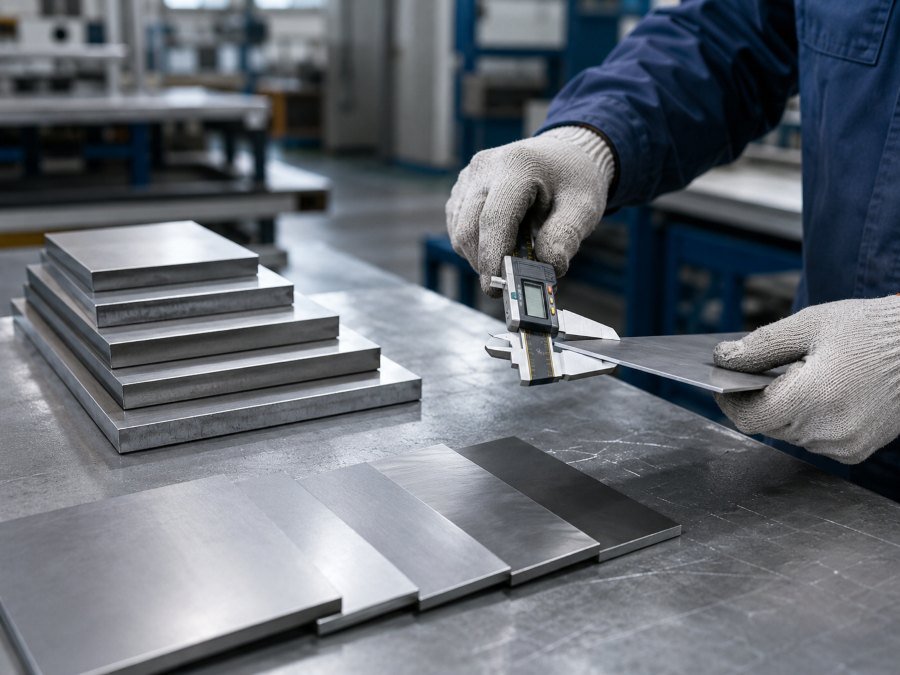
Thickness affects:
- Required stamping force
- Mold clearance
- Bend radius
- Hole quality
- Springback
- Tooling strength
- Material cost
- Part stiffness
A 0.3 mm stainless steel contact and a 3 mm steel bracket may both be stamped components, but their tooling requirements are very different.
Thickness can also influence whether a feature is practical.
For example, extremely small holes relative to sheet thickness may be difficult to punch reliably.
Similarly, sharp bends in thick or hard material can increase the risk of cracking.
For this reason, the manufacturer should review both the material grade and thickness during DFM.
How Does Material Affect Metal Stamping Tolerances?
Material properties can influence dimensional repeatability.
Factors such as:
- Springback
- Hardness
- Material thickness variation
- Grain direction
- Tensile strength
- Forming stress
can affect the final geometry.
For example, springback can influence a formed angle after the stamping force is released.
Harder materials may also require greater forming force and more robust tooling.
This does not mean tight tolerances are impossible.
It means that tolerance requirements should be evaluated together with the specific material and feature geometry.
How Does Material Affect Tooling?
Stamping tooling must be designed around the material being processed.
Material characteristics can influence:
- Punch-to-mold clearance
- Punch and insert materials
- Tool coatings
- Lubrication
- Forming sequence
- Bend compensation
- Tool maintenance frequency
Hard or abrasive materials may accelerate tool wear.
Soft materials can create other problems such as galling or surface marking.
For high-volume production, even small tooling and wear differences can affect long-term production stability.
How Does Material Choice Affect Stamping Cost?
Raw material is often a major part of the finished component cost.
However, material price is only one factor.
| Cost Element | Material-Related Impact |
|---|---|
| Raw Material Price | Different alloys can vary substantially in cost |
| Material Utilization | Scrap rate affects effective material cost |
| Forming Difficulty | Harder materials may require greater press force |
| Tool Wear | Some materials increase punch and mold maintenance |
| Surface Treatment | Carbon steel may need additional corrosion protection |
| Scrap Value | Different metals have different recycling values |
| Quality Requirements | Surface-sensitive materials may require more careful handling |
A more expensive raw material may sometimes eliminate a secondary operation.
For example, selecting corrosion-resistant material may reduce the need for a protective coating.
Therefore, material decisions should consider total manufacturing cost, not only price per kilogram.
How Can Strip Layout Reduce Material Cost?
In medium- and high-volume stamping, strip layout can have a significant impact on material utilization.
Engineers may optimize:
- Part orientation
- Carrier width
- Pitch
- Nesting
- Scrap bridges
- Station arrangement
The goal is to reduce unused material without compromising strip stability or tooling reliability.
This becomes especially important when stamping expensive materials such as copper or specialty alloys.
A small improvement in material utilization multiplied across a large production volume can generate meaningful cost savings.
Material Selection for Progressive Mold Stamping
Material selection is particularly important for progressive mold stamping because the metal strip must remain stable as it travels through multiple stations.
The material may experience several operations, including:
- Punching
- Trimming
- Bending
- Forming
- Coining
- Cutoff
The forming sequence must account for how the selected material behaves at every station.
Factors such as work hardening and springback can influence later stages of the mold.
This is why progressive tooling should be designed around the actual production material rather than a generic sheet-metal assumption.
How Should Engineers Choose a Metal Stamping Material?
A useful material-selection process begins with the final application.
Consider the following questions:
| Question | Why It Matters |
|---|---|
| What mechanical load will the part experience? | Determines strength requirements |
| Will the component be exposed to moisture? | Influences corrosion resistance |
| Does it carry electrical current? | Conductivity may become critical |
| Is product weight important? | May favor aluminum or thinner materials |
| Does the part need spring properties? | May require phosphor bronze or spring steel |
| Is appearance important? | Affects material and surface finish |
| Are there difficult bends or draws? | Formability becomes critical |
| What is the expected annual quantity? | Affects tooling and material economics |
| Is a coating required? | Adds cost and processing steps |
In many OEM projects, the customer already specifies the material.
When the material is not fixed, discussing functional requirements with the manufacturer can help identify practical options. Material knowledge is also an important point when comparing potential stamping suppliers. How to choose a precision metal stamping manufacturer in China.
What Information Should Be Included in a Material Specification?
For an accurate RFQ, avoid descriptions such as:
Steel
or:
Aluminum
whenever more specific information is available.
Instead, provide:
- Material type
- Material grade or alloy
- Temper or condition where applicable
- Material thickness
- Surface condition
- Coating requirements
- Applicable standards
- Special mechanical-property requirements
For example:
Stainless steel, specified grade, 1.0 mm thickness
is far more useful for manufacturing evaluation than simply:
Stainless steel part.
Complete information helps reduce quotation assumptions and avoids material misunderstandings after tooling begins.
Can the Manufacturer Recommend an Alternative Material?
Sometimes.
If a component is still in development, the manufacturer may identify another material that:
- Forms more reliably
- Costs less
- Reduces tool wear
- Is easier to source
- Eliminates unnecessary secondary processing
However, a material substitution should never be made solely for manufacturing convenience.
The alternative must still meet the functional requirements of the final product.
Important properties such as:
- Strength
- Corrosion resistance
- Electrical conductivity
- Thermal performance
- Regulatory requirements
must be considered before approving a change.
Metal Stamping Material Selection at Xiyu Hardware
Dongguan Xiyu Hardware & Electronic Co., Ltd. provides custom precision hardware manufacturing for OEM and ODM projects.
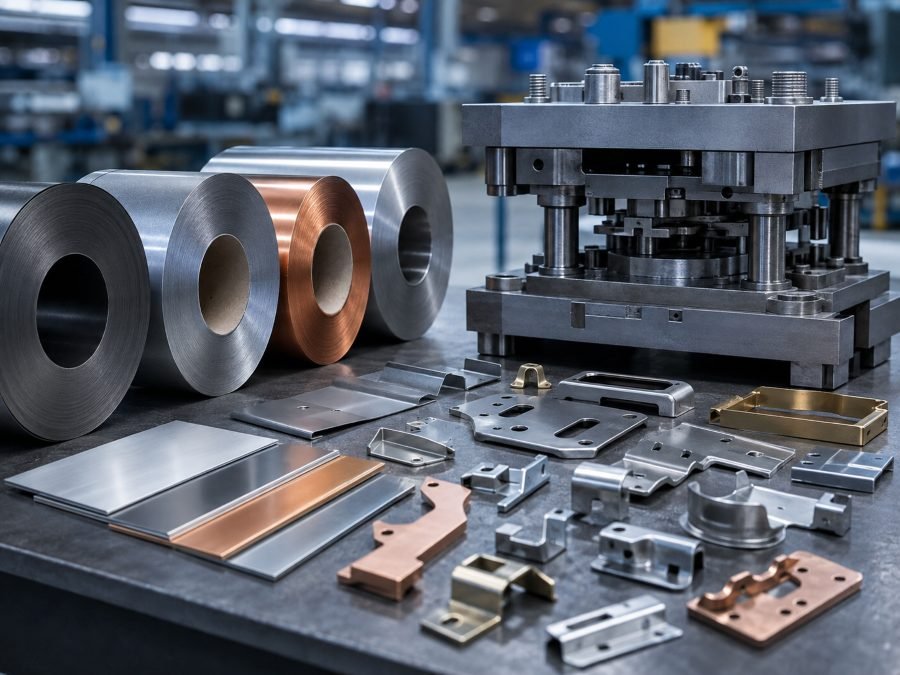
Its manufacturing capabilities include:
- Metal stamping mold design and manufacturing
- Precision metal stamping
- CNC machining
- CNC turning
- Sheet metal fabrication
- Secondary hardware processing
The company supports custom hardware components used in electronics, lighting, machinery, automotive applications, furniture hardware, consumer products, and other industries.
During project evaluation, material selection can be reviewed together with:
- Part geometry
- Material thickness
- Tolerances
- Surface treatment
- Production quantity
- Manufacturing process
This helps determine whether stamping, progressive mold stamping, CNC machining, sheet metal fabrication, or a combination of processes is more suitable for the component.
Frequently Asked Questions About Metal Stamping Materials
What is the most common material for metal stamping?
Steel, stainless steel, aluminum, copper, brass, and other sheet-metal alloys are all commonly stamped.
The most appropriate material depends on the application and required properties.
What is the easiest metal to stamp?
There is no universal answer.
Formability depends on the specific alloy, temper, thickness, geometry, and stamping operation.
A material that is easy to bend may still behave differently during deep drawing or complex progressive forming.
Can stainless steel be precision stamped?
Yes.
Stainless steel is widely used for stamped parts, although it generally requires careful tooling design because of its strength, springback, and forming characteristics.
Is aluminum suitable for metal stamping?
Yes.
Aluminum is commonly stamped for lightweight components, particularly in electronics, lighting, automotive, and consumer-product applications.
The alloy and temper should be selected according to the forming requirements.
Why is copper used for stamped electrical parts?
Copper provides excellent electrical conductivity and good formability, making it suitable for contacts, terminals, and other conductive components.
Can different materials use the same stamping mold?
Not always.
Different materials can have different hardness, thickness, springback, strength, and forming behavior.
Changing material may require adjustments to mold clearance, forming geometry, or process parameters.
Need Help Evaluating a Material for a Custom Stamped Part?
Choosing a metal stamping material should balance product performance, manufacturability, quality, and total production cost.
When requesting a quotation, send us your:
- 2D engineering drawing
- 3D CAD file
- Material specification
- Material thickness
- Required tolerances
- Surface treatment
- Estimated production quantity
Xiyu Hardware can review the component requirements together with the intended manufacturing process.